Showing posts with label cheny. Show all posts

Tuesday, April 19, 2016

Core Post 5: I like Youtube

So much of the “television” I watch nowadays consists of Youtube tutorials, vlogs, and haul videos. 


Show me how much washi tape you bought today.

I like to think that this avoidance of cinematic, narrative, scripted, and produced content represents a burgeoning interest in the kind of "new media" we've been talking about throughout the semester and NOT an indication that my brain has already shut itself down for (eternal) summer vacation. In any case, I look at this subset of Youtube videos, which fall into the recently profitable 'Lifestyle' category of social media content, as being specially positioned at the intersection of multiple discourses from this and past weeks: TV and the Internet, producers and consumers, private and public space, personal authorship and commercial sponsorship.

In "Reload: Liveness, Mobility, and the Web," Tara McPherson (Hi!! :-D) identifies the initial distinctions between television and the Internet (in its relative infancy) that have become so nebulous today. While both mediums are united by and contingent upon an "illusion of liveness," TV was historically seen as a passive experience, through which audiences were encouraged to identify with onscreen content via a fixed gaze. In contrast, the Web represents three different "modalities of experience," categorized by McPherson as: volitional mobility, the scan-and-search, and transformation. To summarize them: 1) A sense of mobility and agency driven by volition is represented by the cursor, which marks our presence and trajectory, tracking "clicks" or choices that “guide” our virtual movements; thus desire is formed and transmitted through the processes of “liveness” or “real time.” 2) The scan and search is an expression of volitional mobility, a lateral impulse toward 'the next thing' rather than an imposed unity or fixed gaze (as with TV). And finally 3) The promise of transformation is embedded in all Internet processes for they offer the opportunity to “[remake] information into a better reflection of the self” (205). Of course these modalities of experience are often a by-product of corporate machinations and are not without ideological consequences. McPherson questions how Web spaces might train their users for a "new Neo-Fordist experience" (207) and "enable specific selves and particular publics" (205).

While Youtube is a media exhibitor with its own structures of engagement distinct from other websites, Youtube Lifestyle videos (haul vids, vlogs, reviews, and tutorials) do engage with ideas of desire and liveness through apparent authorship. With roots in lifestyle blogging, many Youtube "authors" have capitalized on bedroom content creation as a democratic and transparent space through which corporate bodies (such as those mentioned in McPherson's article) might be counteracted or filtered out. The subjects, hosts, authors, and producers of these videos are the Everyman or Everywoman, teaching viewers how to successfully apply a smokey eye from a fellow consumer's perspective. Yet desire and liveness play a key role in the videos' educative appeal: one key aspect of engagement is the viewer's identification with the video producer. Check these GRWM (Get ready with me) videos (1.6 million results!!):
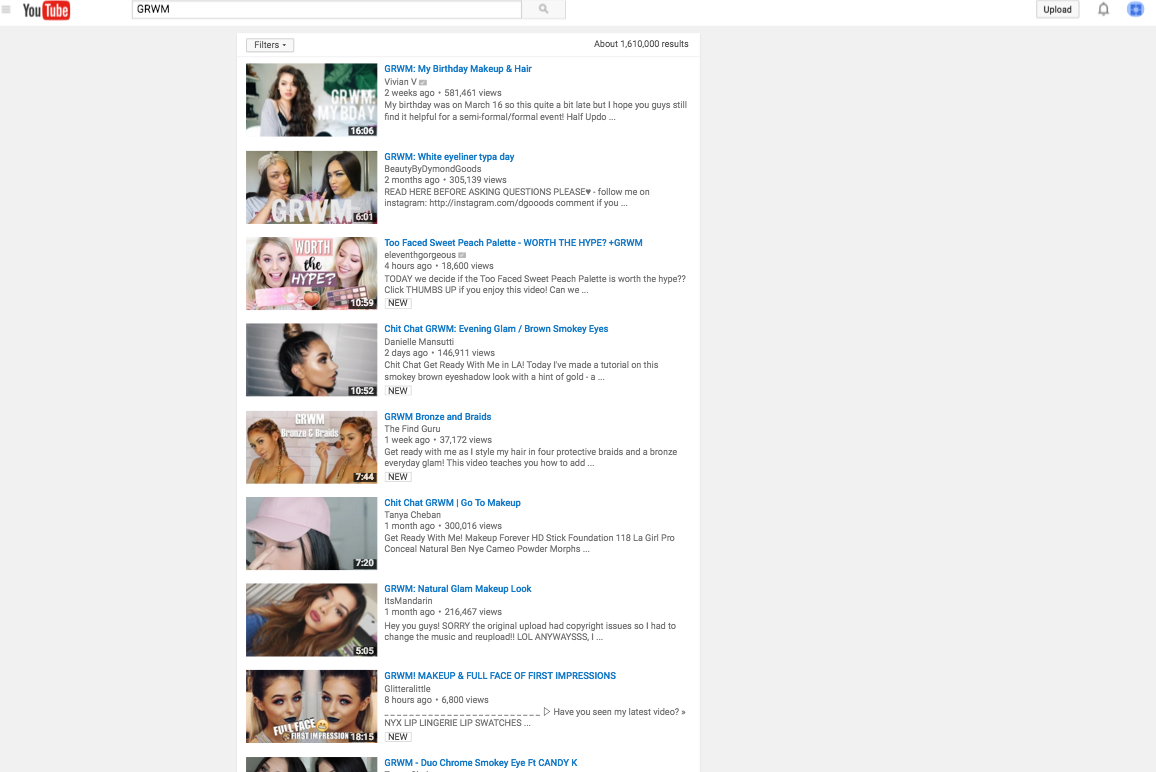


Viewers get to feel like they are occupying the same time and space as the producer, and producers work hard to make it feel as if the video is a collaborative effort and shared experience -- the assumption is that together, producer and consumer are getting ready for a night out or unboxing a new product or driving to check out a new coffee shop. Such an intimate unveiling of personal life thus becomes an avenue of commerce and instruction: as producers build relationships with their viewers, they not only expect participation in return (Subscribe, comment, and share plz!), but implicitly adopt positions of power through the subject position. One need only look at "career" or "veteran" Youtubers such as Zoella, Michelle Phan, Pixiwoo, and Jenna Marbles to locate how an industry can be built around the "I" of a video blog--via the merging of work and leisure, research and entertainment, labor and merchandise, within what McPherson calls a "neo-Fordist feedback loop" (206). Furthermore, as companies and corporations have become alert to the power of the lifestyle vlogger, sponsorships, advertisements, endorsement deals have emerged as a by-product and marker of their success.

Not only can you be a Youtube partner,


You can be an outside brand ambassador:


This has sparked a pretty recent conversation (though long in the making) about transparency, trust, and industry practice, in which consumers have begun to draw dividing lines and to negotiate the conditions of their loyalty within the creator/consumer relationship:

New FTC guidelines for sponsored content
Can You Really Trust a Beauty Blogger?


More things to think about: How do Youtube and Youtubers continue to structure the volitional viewing experience for their watchers? How might the 'double construction' of such content both indoctrinate and alert viewers to their own practices of image construction?


Wednesday, April 13, 2016

Core Post 4

It’s important not to universalize irreducible differences or romanticize the “cross-demographic” effects of globalization -- when in fact our understanding of the concept is largely based on a series of myths. Shanti Kumar breaks down some of these myths while encouraging practitioners of media and television analysis to engage in dialogical rather than dialectical discourse. In her attempt to define "global television studies," Kumar cautions against trying to create a “grand unified theory” (for it is “doomed to failure”) and also eschews comparative discourses which must assume a cultural and philosophical position in their essence; rather, she believes the goal of global television studies is to account for difference, or as she puts it, a fundamental “incommensurability.” Basically, there's a way in which television cultures across the world just don’t "add up" -- and that’s ok, or rather, that’s the point.

While there has undoubtedly been a flattening of national, cultural, and industrial boundaries due to the Internet, it’s important not to assume that difference is elided through such flattening. Looking at stars and celebrities as sites of cultural difference within a largely “universalizing” film, television, and music industry, we might see how incommensurability is delineated rather than minimized through stars as national products. In recent years, celebrity exports from Canada (Justin Bieber, Carly Rae Jepsen, Ryan Gosling, Rachel McAdams) and Australia (Nicole Kidman, Cate Blanchett, Naomi Watts), the UK (Madonna, One Direction, Adele), and South Korea (Psy, Girls Generation, BIGBANG) have been especially common. Many of these stars have been absorbed into American culture as part of the Hollywood system or as reigning pop icons. Bieber in particular has been referred to as "America’s sweetheart" despite his Canadian origin.


Though a cultural studies analysis might delimit such stars as primarily cultural products of economic and industrial value, OR as nexuses of consumer engagement and discourse, Kumar might suggest these disciplinary analyses could be broken down beyond the dominant approach. How might Justin Bieber represent a Canadian identity which is flushed out in the construction of his own “Americanness” and where do the national boundaries of these neighboring countries lie? How might Hollywood’s naturalization of Australian talent reflect and refract the fluidity or primacy of “Westernness” as a loose and arbitrary geopolitical construct? How does the recent domination of British musicians coincide with a return to traditionalism amidst American’s own turbulent racial and political conflicts? How might South Korean pop idols illuminate the cultural anxieties of their fans in various national sectors through their omnivorous portrayals of wealth, excess, and sexuality? Meanwhile, how do global television cultures assimilate and adapt concepts of star and celebrity across local and international platforms? 

While still probably "disciplinary" in conception, perhaps celebrities' fluctuating roles as citizens and ambassadors, image-bearers and image-makers can help discover diversity, through their incommensurability in belonging to both the local and the global.  

Tuesday, April 5, 2016

Core Post 3

In "The cultural logic of media convergence" Henry Jenkins discusses the changing media landscape (in 2004, as it were) and its potential for "remapping globalization.' Not only do western media products flow toward the developing world, "the flow of goods, workers, money and media content" continues to flow from east to west" (41), creating a "new pop cosmopolitanism" amongst media producers and consumers worldwide.

To me, this seems inextricably tied to Jenkins' next identified "site of negotiation" -- "Re-engaging citizens," as media convergence continues to "blur the lines between consumption and citizenship." In Anime's Media Mix: Franchising Toys and Characters in Japan (2012), Mark Steinberg identifies what transmedia (media convergence) looks like in Japanese culture, under the term "media mix." Broadly speaking, it draws an argument for how transmedia in Japanese culture long preceded the Digital Age, due to the merchandising and franchising of characters across toys, games, TV shows, and print media, with Astro Boy (created and serialized in 1952) acting as the first "template" of character merchandising. Such a character-based media ecology would influence global economic models "from Hong Kong to Hollywood," leveraging characters as both a material commodity and a nexus of virtual engagement.

However, Steinberg also discusses how the purposeful marketing of Japanese (character) commodities as a central part of Japan's global economy (beginning in the 1950s and 60s) also affected its national identity. Looking at the prevalence of character-based industries in Japan, from Gundam to Kawaii fashion to Studio Ghibli, it's easy to see how "anime's media mix" has radically altered our image of Japan as a nation-state, as well as its own political economy.

In 2016, Western economies, cultures, and individuals have continued to engage with, adopt, and appropriate commodities from countries like Japan, China, and South Korea to an unprecedented extent. As Jenkins states, "A new pop cosmopolitanism is being promoted by corporate interests both in Asia and the West but it is also being promoted by grassroots interests, including both fan and immigrant communities, who are asserting greater control over the flow of media content across national borders" (41). He questions the long term cultural impact of such trends.

Some of my own questions -- If the formation of "fan and immigrant communities" continues to relegate Eastern cultural commodities to the realm of the "pop," are there less limiting ways to consider the national/cultural impact of "east-west flow"? Have recent viral media like "Gangnam Style" and Emma Stone helped us to engage our own understandings of national identity or do they lend themselves to elision and caricature? It seems to me that a commodity-based cultural exchange has strong implications for how we see ourselves and how we see others. (If you've seen the most recent season of Girls (HBO), the episodes with Shoshanna in Japan to me seem to exemplify this problem.)


Wednesday, February 24, 2016

Core Post 2

I wasn't sure if I wanted to post this, but I wonder if I am the only one who had a problem with Esposito's article on Ugly Betty? While I don't disagree with her reading of the episode "Betty Meets YETI", I felt that the essay invoked strong assumptions about the show's surface text while mostly functioning as a polemic against such cultural notions as "reverse discrimination." Furthermore, the analysis lacked context about the show's production and reception. At one point, Esposito contends that the show is hindered by its comedic premise, which allows complex topics to be "taken less seriously" (527). Her call to reconsider popular notions of a "post-racial," "color-blind," and meritocratic reality is persuasive, but uses Ugly Betty's text only as incidental evidence, a singular case study. What larger cultural work might Ugly Betty have been trying to accomplish? How might the show's other episodes, its channels/patterns of release, its network development, and its fanbase have generated progressive or transgressive results?

While television programs are defined in the essay as notable for both "reflecting and constituting majority culture" (524), I would argue that the goal of Ugly Betty was always to create a character with the agency to embody multiplicity -- the opposite of stereotyping, it makes the argument that Betty is defined by, but not limited to her ethnic/racial identity. Whether this is expressed in meritocratic terms throughout the show is debatable to me -- ought the audience to support a Latina protagonist who claims the ability to make her own choices? Or ought we to see this choice as a win for dominant white hegemony and a loss for racial visibility? Esposito argues that Marc's failure to interrogate his own white privilege is a point of failure in the episode as a narrative and political whole -- however, isn't this where irony and humor are used to their best advantage? As Betty points out Marc's advantages as a white, gay male in the fashion industry, he denies them while receiving free concert tickets. Here, the audience witnesses Marc's privilege even if he doesn't admit to it himself. The moment is humorous, but that doesn't make it meaningless or "less serious." Far from constructing a "typical" Latino/a personality in the public imagination, I think the show grapples with Betty's identity politics as a Mexican American while trying to make her singular. Perhaps instead of doing too little, programs like this (including today's Fresh Off the Boat and Black-ish) could be judged as attempting too much...

Just quickly, I'd also like to note that the article limits its discussion to only black, white, and brown people groups. Asian people have had a long relationship to meritocracy in the United States and have defined the politic of "model minority" which is so often used against groups with a more unstable record of "success," yet none are mentioned as fellow people of color. While perhaps burdened by fewer systemic disadvantages, the image of Asians and Asian Americans has been strongly (and mostly negatively) coded by Hollywood in the past century to the proliferation of regional homogenization, rampant stereotyping, and a silent majority. While not a "social problem," Asians in American media represent mostly an ellipsis, defused and decentralized if seen at all. Aziz Ansari's Master of None seems to be the latest TV series to deal with this non-representation, through comedy no less. Yet he was criticized on the episode "Indians on TV" for comparing the hypervisibility of black men and women to the invisibility of South Asians. Does this, and Esposito's article, suggest that there is not just a hierarchy of privilege, but a hierarchy of struggle that should be acknowledged when it comes to race in media?

Wednesday, February 3, 2016

Core Post 1 (Cheny Ng)

Far from condemning daytime television as a “distraction” for American women in 1950s, Tania Modleski argues that it was in fact a woman (wife, mother)’s role to be distracted and distractible, and that television simultaneously enforced that state of distraction, reflected it back, monetized it, and engaged with it to elicit pleasure. To the latter, Modleski re-contextualizes television not as escapism, but as a force which extends the woman’s world, creating intimacy and pleasure while reinforcing the limiting paradox of their social identity—switching instantly from “bedmaking, dishwashing automaton to a large sympathizing consciousness” (72).

Modleski argues that soap operas, in their ceaseless deferment of resolution, do not offer the possibility of success but keep women in a state of “decentered-ness” (through close-ups, they focus women’s attentions on reading others’ needs/emotions and through commercial/narrative breaks, they mirror a state of interruption). The female audience’s pleasure then is one of “nearness” rather than identification: it provides an “extension of their world,” a sense of camaraderie and social investment, but ultimately (as I see it) no agency—no opportunity or impetus to “become,” relegating women to the eternal service of others.

Similar to the use of humor in situation comedies discussed by Patricia Mellencamp (Situation Comedy, Feminism, and Freud), pleasure in Modleski’s reading can be read as a reification of woman’s existence for the benefit of others. Like Freud's humor, pleasure in the soap opera allows the fulfillment of the ego through the sublimation or deferment of inner conflict (Mellencamp calls humor the substitute of affect; I would call soap operas the substitute of agency). As Mellencamp says, the female spectator and performer are interchangeable—the “containment” created by the situation comedy echoed a larger policy of containment on political as well as domestic fronts. Together with Modleski’s idea that the pleasure created by soap operas is one of “nearness,” one might say that the pleasure experienced by the female spectator is derived from the feeling that—whatever realm she may occupy—she is not alone.

This is an interesting designation that I am now considering in the context of contemporary “women’s” television programs. While many recent programs have targeted intimacy between women as a “new” mode of central storytelling, I wonder which of these actually allow agency and affect instead of substituting it. In network programs directed toward women such as Pretty Little Liars (ABC Family), Desperate Housewives (ABC Family), Gossip Girl (CW), and Reign (CW), a woman’s agency is often interrogated; however, these shows mimic soap operas in the sense that resolution is constantly deferred, storylines are constantly shifting, and characters’ reactions/conversations take priority over continuity. Audiences often stop tuning in for story continuity and begin to see the characters as friends—each of these shows features an ensemble cast of gorgeous women (and their gorgeous male partners), each distinct and fashionable (and marketable) in their own way. Viewers are encouraged to identify: if you don’t resonate with bohemian Serena, you might see yourself as a Blair (remember the Team Serena/Blair split)? If you’re sick of Felicity Huffman’s story, you can tune in for Eva Longoria’s.


Distinct from the soaps of the past, is there a nearness here, as well as identification? The rise of internet technologies means audience members can access the lifestyle of the stars more easily than ever before. Watching is anything but idle—viewing parties, episode breakdowns, and live tweet-alongs are commom. This strong participation isn’t built upon the shows’ prestige or quality, but on fans’ labor and devotion; in other words, fans are central. It seems that fans continue to experience intense closeness ("not alone-ness") with characters, but also that viewers are enacting agency rather than enforcing limits through their watching. 

I ask: Are these programs continuing to entrap women within the objectification and capitalist consumerism that drives hegemony and limits agency? Or is the emergence of fan studies a sign that new forms of engagement between women onscreen and women in the audience are interpellating women to "become" rather than "substitute?